Saturday, August 4, 2012

What lazy days of summer?

No lazy days of summer here. The University of Illinois starts its fall semester at the end of the month and I had four apartments turn over the end of July. Good turnovers--two tenants finished PhDs and got tenure track jobs elsewhere, two moved to larger quarters with significant others. I found great new tenants and am looking forward to a happy year. But there were things to be done before new tenants move in --painting, changing light fixtures and so on--and everything had to be done between the end of July and the beginning of August. And was!

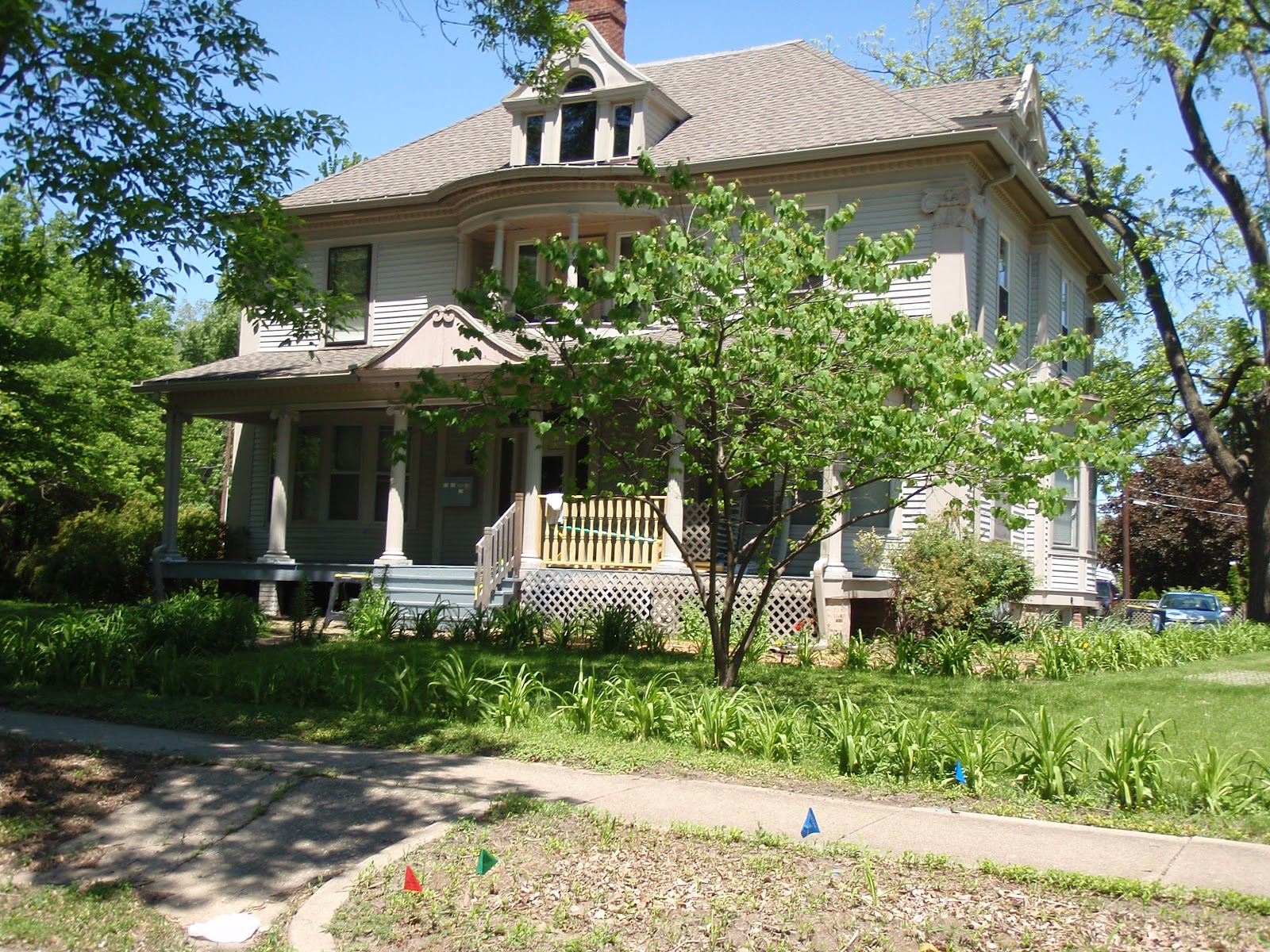
So no writing for a bit. My buildings--two old mansions now divided into eight apartments--support me while I write, providing a place to live and work to do and more, smart and interesting tenants who are around but not too much so.  This year I have a geographer, a linguist, an engineer, a medical student, a law student, a musician and a man who sells science fiction books on the internet. Oh, and two psychologists. All good for the odd chat over the washing machine.

All this moving in/moving out business came at a perfect time for me. I just finished editing and proofing my second book, RAVENSWOOD, the Second Chicago Story and have put it away for a bit before I go back and read it through at speed to try to catch any remaining nasty bits.  Then its off to the formatter (Hitch at Booknook.biz). I'm also waiting for Dustin Ashe (Indyarmada.com) to come up with another cool cover. All this built-in waiting time is much appreciated after total immersion in editing and proofing. My poor battered brain needs the break.

The drought here is horrendous. My gardens are essentially burnt out, the grass is long dead and even the trees are beginning to wilt. That lets me off gardening, so I'm thinking about finally cleanng up my basement, limewashing the walls, painting the floor, all that.  Yikes!  A clean basement. What a concept. Must be the heat.


Sunday, July 15, 2012

I've spent the last month rewriting Ravenswood. My editor sent it back with extensive comments and a marked-up manuscript. The problem was, she was right. Once I got my battered ego out of its hiding place in the closet, I realized she was dead on. Finally someone had pointed out exactly what I was doing wrong--a lot--and suggested ways to fix it. I set about doing just that. when I finished, my 82,000 word novel had swelled to 109,000. Yikes. Now I'm proofreading it before I send it out to two lovely volunteer proofreaders and trying to clip out a word here and there to bring it down to maybe 100,000 words. Maybe. It's a better book than it was, and I think, a better book than my first, West of Western.

Rewriting/editing fascinates me. I have a sense of discovery, as if each change shows me more of my characters, opening up new dimensions and insights. Most of my changes are in the service of making my characters more accessible to my readers. With Chicago Stories: West of Western,  I had more than one reader comment that Seraphy seemed rather distant, but I had no idea how to change that. Until my editor, Elizabeth Lyon, pointed her mighty pen at the problem. I hope the new Seraphy is more reader-friendly.

I suspect the problem is really more about me than Seraphy. I am a very reserved person. Not unfriendly or shy, just that there is much that I keep to myself--like my characters, apparently. Writing is a lot like sitting in a shrink's office--trying to figure out just what my characters are feeling and thinking and getting that out there.

We are now officially in the midst of a severe drought. Like we haven't noticed. I've christened my yard 'Mohave,' and Urbana may have to cancel its wildly popular Sweet Corn Festival for lack of corn. I  water my hostas every few days, but my grass is on its own and has mostly gone dormant. For the first time I can remember, the old-fashioned lilies have turned yellow and look like they're dying. I don't think anything short of a neutron bomb can kill those suckers, so I assume they'll will return with the rain. If it ever rains. They say its the hottest year ever recorded and the future will be worse. I can't understand how anyone can still deny global warning.Not that the earth will die or anything like that, Mother Earth has seen much, much worse. We haven't. Yet.  

Friday, June 15, 2012

FREE Days for CHICAGO STORIES: WEST OF WESTERN

FREE! CHICAGO STORIES: WEST OF WESTERN is free today, tomorrow and Sunday on Amazon!
If you read it and like it (and how could you not?) please consider writing a review on Amazon. they use the reviews to decide which books to promote and your review would help a lot.

Thursday, June 7, 2012

Running Away to Chicago!

First: the link is to Amazon and Chicago Stories: West of Western because that's the only book I have on Kindle now. But I'm writing this as I revise Along the Ravenswood, the second of my Chicago Stories.

Yesterday I drove to Chicago to get some photos of Louis Sullivan's Krause Music Store for my new cover. Dustin Ashe made me a  great cover, the one you see here, last year. I love it. but in the meantime, much to my surprise, the book has grown and changed and now this great cover doesn't fit anymore. So . . . I went go get some material for Dustin (poor boy scratches a living in California, so sad). The facade of the small store was Sullivan's last known commission, finished less than two years before his death.  the building's listed and discussed on the National Register of Historic Places.

I wanted a good shot of the whole facade and the weather was perfect, one of those crystal clear, cool, sunny days that make site work a joy. When I actually arrived at the store, though, I found the little tree I remembered being in front was now a much larger tree, so unless I wanted a shot of the tree with bits of building peeping through, I was out of luck. I did take some twenty detail shots, and have posted one for you. Dustin will have to check out the Nat'l Register to see the entire facade.

Architect Louis Sulllivan, often called the father of the modern skyscraper, was one of the founders of the Chicago School of Architecture. Sullivan and Dankmar Adler, developed the caisson foundation, making possible steel-framed curtain wall high rises. supposedly Adler developed the foundation and structural elements, Sullivan the facades and ornamentation.

My interest lies more in the small buildings Sullivan designed later in his life when, he was no longer the fashionable architect of the auditorium years. After his death, a friend burned his papers, saying there were personal detail the public need never know. Nor do we know what Sullivan was doing in those years. We have eight small banks scattered around the Midwest (notably the Merchant's Natrional Bank of 1914 in Grinnell, Iowa, the so-called Jewel Box Bank), and the Krause Music Store facade at 4611 North Lincoln Avenue in Chicago. In Along the Ravenswood, Seraphy's old architectural history professor discovers a lost Louis Sullivan church from these years not far from the Krause Music Store and commissions Seraphy to convert the little church to a private library for Sullivan studies. I'm asking Dustin to use bits from the  music store and from the Getty Tomb, an earlier structure with wonderful bronze grills and geometric designs in stone, for the cover.

And I thought you might like to see what all the excitement, at least mine, was all about.

Sunday, June 3, 2012

Lost in the land of Rewrite

Sorry, I know I promised to write more often. Mea Culpa. I've been working on my second Seraphy Pelligrini novel, CHICAGO STORIES: WEST OF WESTERN. Well, sort of. My editor sent me the annotated manuscript and over 40 pages of notes in April.  Shock! What? My wonderful novel has so many problems? How is that possible? Followed by devastation. Maybe it wasn't worth revising. I'd lick my paper cuts and tend to my other life (as a landlady in a university town, more about that another time).

I spent the last two weeks of April and the first week of May in denial, reading my way through some of the sixty or so mysteries I'd downloaded and never managed to get to on my Kindle and attempting to cope with the garden.  This part of Illlinois was once forest and apparently wants to be that again. I pull walnut, maple and red bud trees up like less fortunate folks pull pigweeds. In a moment of madness two years ago, I planted some of those orange lilies (I call them grandma's lilies) at the edge of the yard (cheaper than a fence). Nobody warned me. They're as tall as my head now (the blossoms) and spreading like crabgrass. The good side is that in a few years I won't need to cut the grass. There won't be any grass left. The bad side is that I'll need a machete to get to the house.

Three weeks ago I had had enough of farming and decided to look at the manuscript again. Yikes. Now Elizabeth's (Lyon) comments had had time to settle I realized she was dead on. Seraphy Pelligrini, Tommy MacKinnoin and company were fine. The plot was all right. But my scenes--well, to be honest, some of them weren't even scenes, just rather boring talking heads. Ouch. The good thing was that Elizabeth actually liked some bits here and there.  Even better, I'd known there was something wrong but couldn't figure out what. Eagle eye Lyon spotted the problems and pointed them out. At length.

So that's where I am--up at six and in front of the computer again. I'm trying to do, or redo, a chapter a day. It's a matter of working my way through the scene (or would-be scene), adding some structure, deepening the characters with flecks of backstory and analysis and generally trying to bring everything into alignment. That's all. By eleven or so, my mind has gone on break and I'm no longer capable of reading, much less writing, a sentence. 

So here it is: if you write novels and don't have a good editor, get one. Note the *good one* part. I live in a university town and academic editors aren't hard to find. I had one for CHICAGO STORIES: WEST OF WESTERN. She did a fine job of checking my grammar and finding typos, but wasn't experienced with fiction and had a superficial acquaintance with the genre. I discovered this kind of editing wasn't what I needed. When Kimberley Hitchens (formatter and all around genius of Booknook.biz) highly recommended her indy authors get good editors and suggested Elizabeth Lyon as one of the best, I took the hint. Elizabeth agreed to do a 'substantive' edit for my second Chicago Stories novel, Ravenswood. She doesn't like my title, so that may change. Or not.

Substantive. She wasn't kidding. This time, I had someone with a deep understanding of the genre and brilliant analytic skills. She saw things in my characters I hadn't seen, pointed out ways to make them more three-dimensional, poked at my flaccid scenes, shook me out and pointed the way to go. Substantive editing leaves the author no place to hide. If CHICAGO STORIES: RAVENSWOOD isn't the best book I can write, it won't be Elizabeth's fault.

I originally intended to have Ravenswood on Kindle by now, but I'm only on chapter eight this morning. I'm hoping I can get it up by July. My cover designer, Dustin Ashe, made the cover you see here a while ago, but now with all the changes, I'll have to commission him to do another version. As soon as I get to Chicago to take the photos he'll need--maybe Tuesday--I'll email him with the news.  Hope he has time!

So just know it's coming. Really.

Monday, April 23, 2012

Getting Your Damned Ducks in a Row

I've been reading a lot of indy novels on my Kindle recently. It's just too tempting not to order anything that looks remotely interesting when KDP's offering freebies. The result is a mixed bag, with one or two really good reads (often these are repubs of out of print books), several good reads by new authors, another handful of promising but marred stories, and the rest, the ones that get a quick one-page read and go directly to the 'remove from device' bin.

The most frustrating are books by careless indy authors. Last night and this morning I've been reading a story with a great plot and attractive characters. I'd love the book and look for more, but it's so marred by an apparent total lack of editing and proofreading that I'll probably delete it from my Kindle.

What, you say, would make me do this?  Hmm. The dialog's cstilted (guy, people don't speak in public relations-type paragraphs, especially when being pursued by killers), there's way too much landscape detail, and even irrelevant scenes (the church along the road) dropped in here and there.

Even more distracting, words are misused (birth for berth, for example, and Illusion for allusion) with unintentional results. Often hilarious, but totally disrupting the flow.

I believe in indy publishing, guess you figured that out. And because I'm an indy author myself, it pisses me off to give the critics--and there are plenty--ammunition. I'm wondering how many readers will be turned off after wading through some of the dreck that's out there. I'm even wondering if I would have been one of them. Last year, maybe, before I published CHICAGO STORIES: WEST OF WESTERN.

And I'm pissed because it's all so unnecessary. A good editor (mine's Elizabeth Lyon) and a formatter (Hitch at booknook.biz) aren't all that expensive when you consider your book will be forever on the internet. Probably they'll cost less than if you spent years and $$$ querying and rewriting for traditional publishers--if you found one.

So guys, get your damned ducks in a row before you hit that PUBLISH button. Please.

Saturday, March 31, 2012

Interview with Seraphy Pelligrini of Chicago Stories: West of Western

An Interview with Seraphy Pelligrini

Ex-Marine and Darkpool agent, now an architect in Chicago, Seraphy Pelligrini answers James Liston's ("Inside the Actor's Studio") ten questions.

I wasn't sure she'd be there until I reached Jerrod & Etwin, the storied architectural investment firm where Seraphy worked, and found her red Jeep Cherokee in the lot.
After many unanswered calls and  e-mails, I called in a favor from my friend and her boss, Max Chiligiris. She specified we meet in her office.
When I reached the second floor balcony, I found her expecting me. The door stood open. Seraphy was across the room at her window, a slim figure in a black turtleneck and jeans silhouetted against the grey light of early March. She sensed my arrival and turned from studying the grubby industrial riverfront below. Beautiful in an unstudied way, with that Black Irish coloring that needed no makeup.
"Max tells me I have to do this."
"It's to promote the book."
"Isn't that your job?"
"I'm not the one readers want to know about."
She frowned. "I hate things like this. Can’t they just read the damned book?"
"I'll be gentle."
"That's what they all say," she said with a wry smile. "Let me take your coat." She waved a hand at the client's chair in front of her desk. "Sit," she said and  held out a hand for my coat.
I glanced around. Nice office, big enough to move around in, with an antique drafting board on one side and a large desk and chair on the other. Flat files for drawings, a bookcase full of technical manuals, architectural history books and murder mysteries. Framed architectural photos and renderings on the walls. No photos. My Burbury joined the battered bomber jacket and navy pea jacket in the closet.
She sat across the desk from me, folding her hands in her lap. She wasn't going to make this easy.
"Ready."
"I have a few questions I borrowed from James Liston. What's your favorite word?"
"Excuse me?"
"Just answer the question."
"Cappuccino." Suddenly she grinned. "Yeah, my favorite word is definitely cappuccino. Or sometimes latte."
"What is your least favorite word?"
"Right now? Max."
"Because he's making you do this?"
"You're so perceptive."
I grinned. "What is your least favorite word, seriously?"
"Terrorist."
"What turns you on, creatively, spiritually or emotionally?"
"Besides coffee?" She looked me up and down and her blue/gray eyes sparkled. "Leather, maybe?" She made it a question and I felt myself reddening. 
"Sorry, I couldn't resist. Um, good design, I think. Things that feel like they were always there and always will be. A certain kind of authenticity."
"What turns you off?"
"Ugliness, of form or spirit."
"What sound or noise do you love?"
 "An espresso machine spitting and hissing."
 "Do I detect a theme here? What sound or noise do you hate?"
"Gunshots."
"What's your favorite curse word?"
"Shit! Not really a favorite, just seems to be the go-to word."
"What profession other than you own would you like to attempt?"
"There is no other for me."
"What profession would you not like?"
"Any other."
"My last question: if God exists, what would you like to hear Him say when you arrive at the pearly gates?"
"Your father's waiting for you."
She looked at me, her eyes glistening. "That it?"
"That's it. Thanks for seeing me."
She nodded and watched me get my coat.  I heard her sigh of relief as I went out the door.